.svg)


.svg)
.svg)
AI, Attention, and the Age of Efficiency: How Marketing Leaders Will Win in 2026
Over the past few years, I’ve watched the marketing world from a strange vantage point: part participant, part observer, part reluctant anthropologist. Every conversation felt like déjà vu, with teams overstretched, costs inflating, channels acting unpredictably, and AI promising everything and nothing at the same time.
The real story, though, wasn’t chaos. It was compression. Everything—from budgets, attention, patience to headcount—felt like it was shrinking. And as 2026 approaches, I’m increasingly convinced that this compression is not a temporary phase but the new environment we’re operating in.
This article is my attempt to put some structure around that feeling. It’s not meant as a list of trends (we’ve had enough of those). It’s more of an articulation of what I’m seeing across teams, founders, CMOs, and the marketing leaders I work with: the underlying forces that will shape how we work. And beyond, such as what will separate those who thrive from those who burn out.
Welcome to the Age of Efficiency. Not efficiency as in “do more with less,” but efficiency as in clarity, focus, and deliberate simplicity.

Below is what’s changing, why it matters, and how leaders can position themselves for the year ahead.
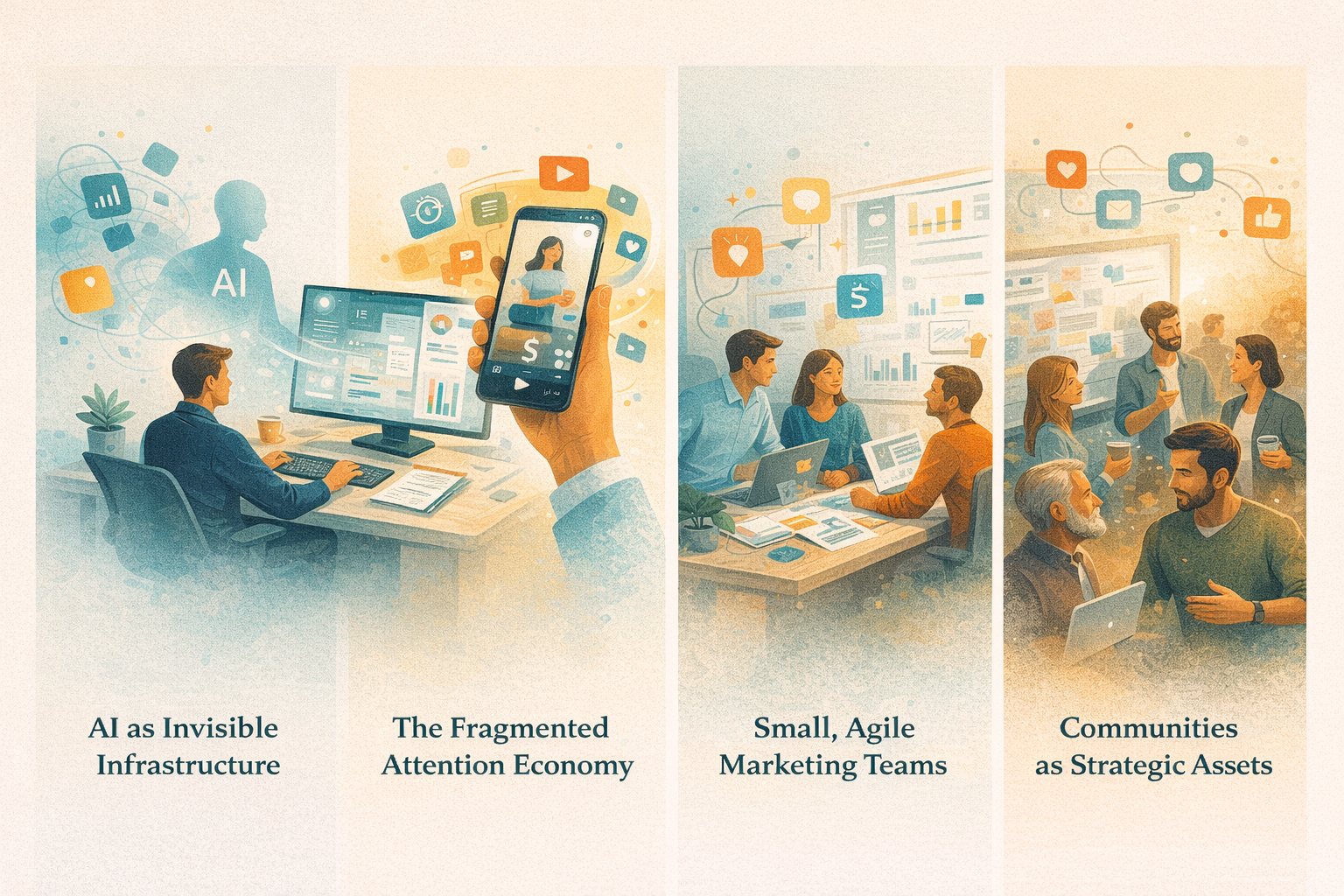
1. AI becomes the infrastructure we stop talking about
We spent 2023–2025 treating AI as if it were a new team member we needed to onboard. We poked it, tested it, worried about it, argued over prompt styles, and tried to fit it neatly into our old workflows. We asked AI to write copy, summarize data, brainstorm headlines and, while we were at it, do some parlor tricks along the way
But 2026 is the year AI disappears into the system. Not gone - AI is here to stay - but absorbed into the machinery. It becomes the equivalent of electricity: you don’t talk about it; you assume it’s running behind everything.
Looking at a typical marketing stack holistically: The CRM predicts intent quietly. The website adjusts based on behavior patterns that would take a human weeks to detect. Analytics explain themselves. Attribution models regenerate based on real-time feedback loops, not quarterly discussions. Your "report" is no longer something you compile; it’s something that emerges.
The leaders who succeed in this environment won’t be the ones who “master AI tools.” That game is already over. Instead, it will be the ones who redesign how their team thinks, assuming AI is the first draft of everything, not the shortcut.
AI doesn’t eliminate marketing work; it compresses it. The thinking expands.
2. The attention economy doesn’t shrink, it fractures completely
We’ve been talking about “short attention spans” for years. But what’s happening now is more dramatic: attention is becoming a series of glimpses, punctuated by algorithmic stimuli, none lasting long enough to support the kind of storytelling we used to rely on.
Content is no longer something people watch, it’s something they skim past, unless it meets them at the exact moment it’s needed.
Marketing in 2026 shifts from broadcasting to ambient relevance. A brand no longer wins because it produces loud, impressive creative, but because it appears at the precise moment when a friction point surfaces or an intention flickers.
It’s the difference between shouting in a crowded room and whispering when someone is leaning in.
This forces an evolution in creativity, not a decline. Creativity becomes more like poetry than prose: evocative, distilled, leaving an emotional or intellectual trace in seconds.
The question creative leaders will ask themselves is no longer “How do we get attention?” but “How do we earn it in the one second we’re given?”
3. Small teams become the definitive model, not a temporary austerity measure
Across sectors marketing teams have compacted. But this contraction didn’t only happen because of budgets. After all, marketing teams are always the ones first affected when money runs short. Now, it happened because the work changed.
AI absorbed executional tasks. Freelancers filled specialist gaps. The need to coordinate eight different roles evaporated when three could do the job with the right support systems.
The teams that succeed in 2026 won’t be defined by size but by shape. I’m seeing a consistent pattern emerge:
- One or two people who act as the system’s architects, thinking across channels, data, and messaging.
- A creator with actual creative taste, not an assembly-line content producer.
- A lifecycle operator who understands experimentation as a language, not a checklist.
- A growth operator who treats channels as instruments, not as silos.
Everything else becomes fluid: contracted, automated, or orchestrated by AI.
This doesn’t make teams lighter in ambition, only lighter in drag. The leaders inside them spend less time on “management” and more on crafting a structure that generates momentum.
What I clearly see now is that in a world where teams are small, the systems they build become large.
4. Data abundance fades; judgment returns to the foreground
2026 will be the year teams finally admit something out loud: perfect data isn’t coming back.
Privacy, platform opacity, cross-device journeys, new attribution restrictions… the list is long. These trends didn’t just complicate measurement, they rewired it. And in this rewiring, something important re-emerges: the necessity of human judgment.
Moving forward, marketers will lean more heavily on mixed-method understanding: a blend of experiments, intuition, quantitative signals, and qualitative conversations.
No dashboard can tell you why a particular segment suddenly disengages. AI can describe what changed, but not what it means. And attribution models—helpful as they are—will become navigational tools, not gospel.
The leaders who excel will be those who know which signals matter and which are noise. The ones who can make decisions with incomplete information, the way real decisions in business have always been made.
If the last decade was about chasing data, 2026 is about learning to interpret it again.
5. Content finds its way back to authenticity, originality, and human voice
The generative wave brought with it the illusion that content creation had been “solved.” It wasn’t. What it did solve was quantity. Which is precisely the problem.
We now live in a world where output is infinite. The constraint is meaning.
Audiences in 2026 will gravitate toward content that feels like it comes from a real mind, formed from experience, enriched by perspective, and sharpened by honesty. AI can mimic tone; it cannot fake conviction.
The best content next year will come from:
- People who have genuinely seen something, done something, or believe something.
- Brands willing to show drafts, failures, and thinking, not just polished outputs.
- Teams who use AI to extend their imagination, not replace it.
And while short-form will continue to dominate feeds, long-form content—especially essays, narratives, deep dives—will thrive in smaller but more loyal circles.
6. Community stops being “nice to have” and becomes strategic insurance
Platform volatility is not an outlier anymore but the default. Channels rise and fall faster than planning cycles. Algorithms change their mood without warning. And the brands most dependent on them always feel one step away from crisis.
Communities—whether in the form of newsletters, private forums, micro-groups, ambassador circles, or member-only spaces—offer something platforms no longer guarantee: stability.
A community is not necessarily a large audience. Sometimes it’s a few hundred highly engaged people who trust the brand enough to stay, buy, and advocate. What matters is that they exist outside rented space.
7. Trust becomes the most valuable currency marketers have left
The wave of synthetic content, deepfakes, automated persuasion, and AI hallucinations has created something subtle but powerful: a global low-grade skepticism. It shows up in user surveys, consumer studies, and even in casual conversations. People are beginning to assume they’re being manipulated unless proven otherwise.
Trust becomes a performance metric.
Leaders in 2026 will think about trust not as a value they proclaim but as a series of behaviors:
- Transparent storytelling about how AI is used.
- Clear opt-ins and respect for boundaries.
- Communication that sounds like a person, not a system.
- A willingness to show sources, intentions, and limits.
Trust cannot be automated. It must be demonstrated, and the brands that do this well will build differentiation that no budget can buy.
In a nutshell, 2026 belongs to the clear thinkers
If the past few years demanded endurance, 2026 demands focus. The landscape won’t get calmer, but it will get clearer for those who learn to filter well.
This won’t be the year AI replaces marketers. It will be the year AI replaces the old version of marketing—the bloated processes, the unnecessary complexity, the endless dashboards, the rituals we maintained long after they stopped delivering value.
The leaders who succeed will be the ones who design simpler systems, sharpen their judgment, and invest in the parts of marketing that machines cannot replicate: trust, creativity, narrative, and strategic thinking.
2026 won’t reward those who shout the loudest or run the most campaigns. It will reward those who understand the landscape deeply, and act with precision.
.svg)
It’s time to stop fighting your data
Whether you’re scaling a startup or running lean at a growth stage, you need reporting you can trust and data you don’t have to babysit.


