.svg)

.svg)
.svg)
Marketers Don’t Need to Become Data Scientists
For the last decade, marketers have been told a slightly terrifying story:
“If you don’t learn SQL, Python, and statistics, you’ll be irrelevant.”
In parallel, the volume of data exploded, dashboards multiplied, and the mythical “full-stack data-savvy marketer” became the unicorn every company wanted to hire.
Then generative AI and AI-native tools arrived and quietly changed the rules.
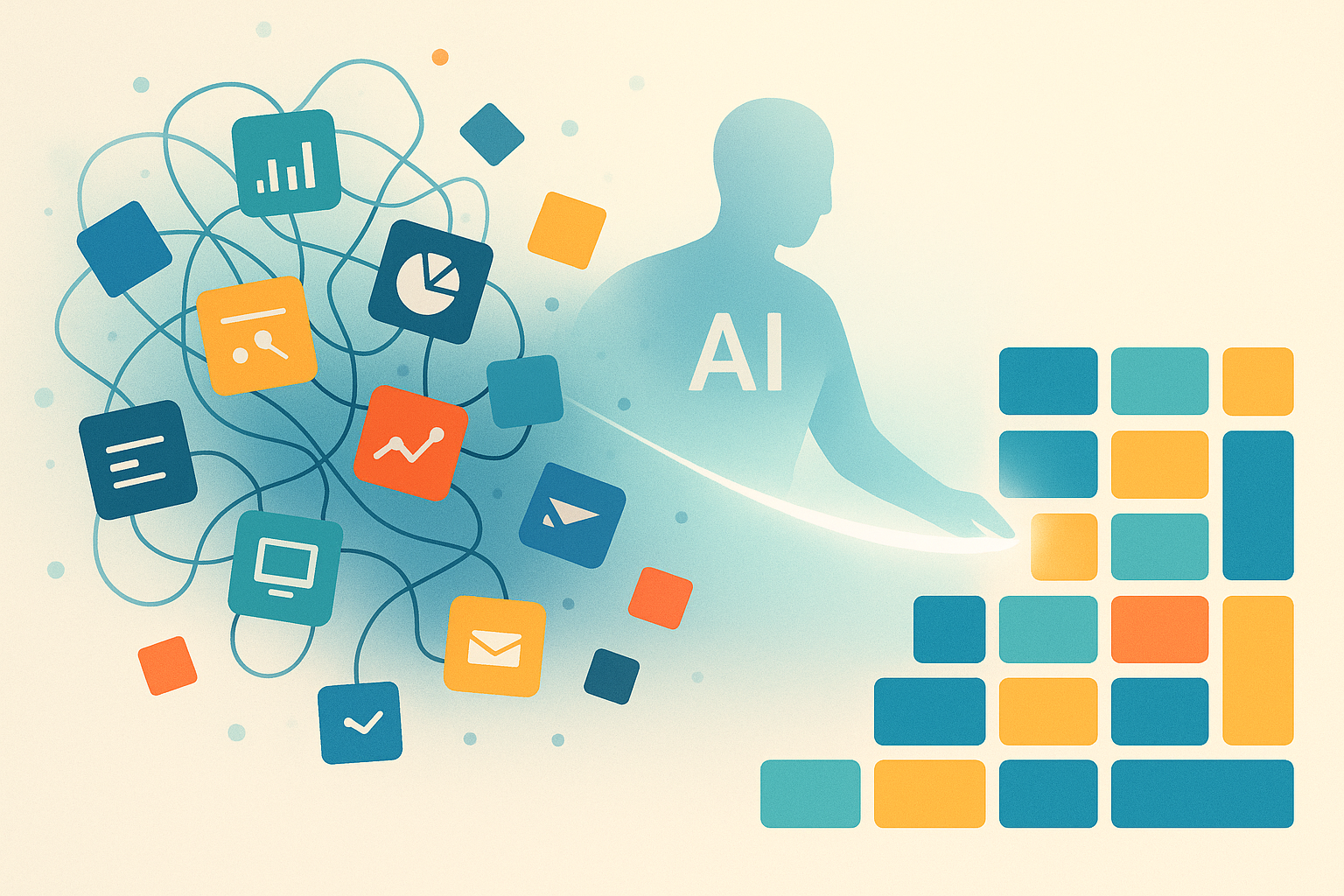
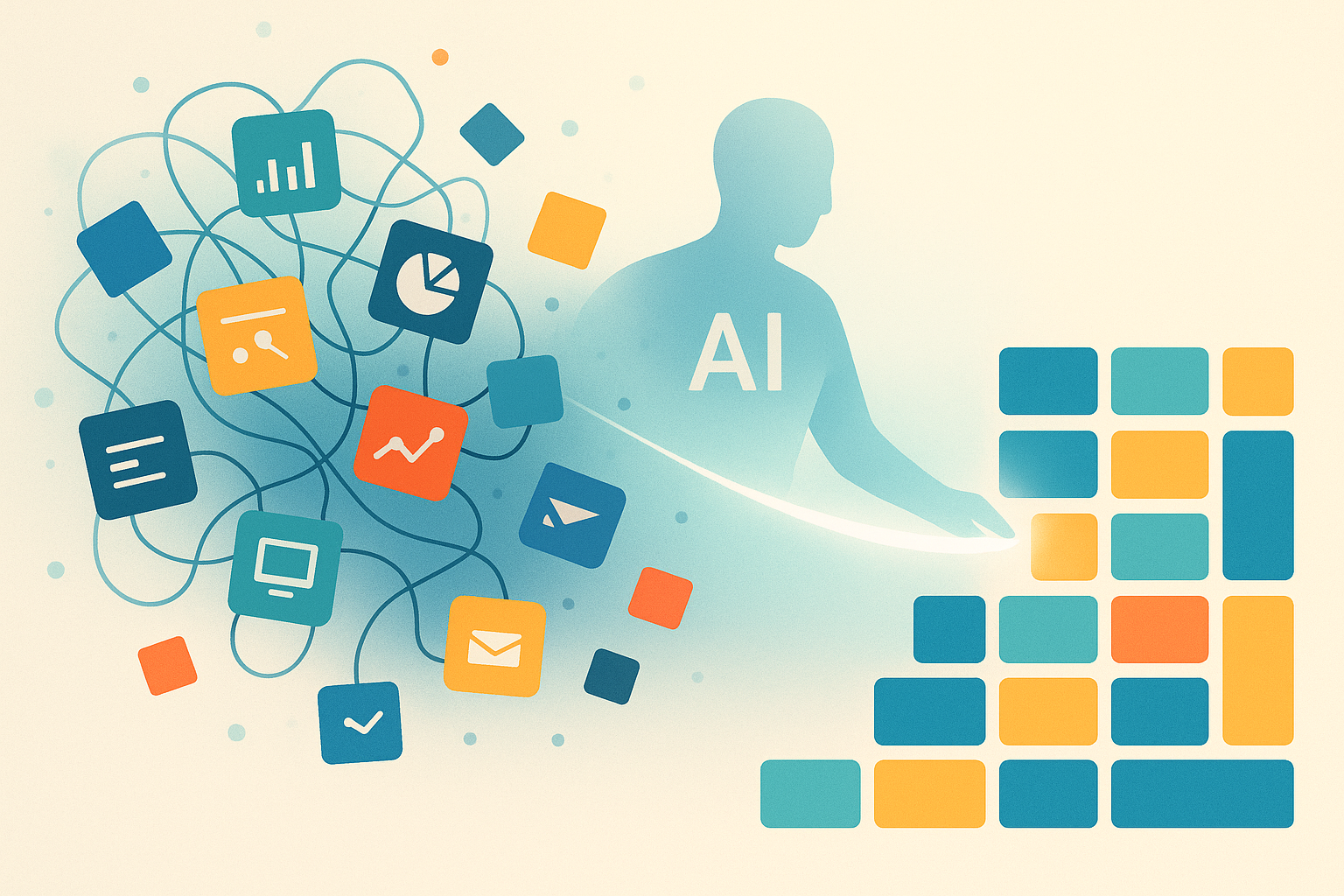
Today, the question is no longer “How do I turn every marketer into a junior data scientist?” but rather:
“How do I give marketers superpowers so they can ask and answer great questions without becoming data scientists?”
This post explores why that shift is happening, what AI is actually doing under the hood for marketing data, and what skills marketing teams really need in this new landscape.
1. The old story: more data, not enough data people
First, a bit of context.
Organizations have been struggling with a data skills gap for years. Reports from IBM, Burning Glass and the Business-Higher Education Forum showed that demand for data science and analytics skills was outpacing supply across industries, creating a “quant crunch”.(bhef.com)
At the same time, the marketing function became one of the most data-intensive areas of the business: multi-channel attribution, LTV/CAC, cohort analysis, MMM, propensity models, incrementality testing, and a swarm of martech tools each generating their own dashboards.
The natural reaction in many companies was:
- Hire a small data team (if budgets allowed).
- Ask marketers to “upskill” and learn more technical tools.
- Hope that somewhere between those two, better decisions would magically emerge.
- Optionally: fire the marketing team and hire another one, hoping this one will just do the trick :)
Yet even today, most companies still struggle to unlock real value from AI and data. A 2025 BCG study found that only 5% of companies are meaningfully benefiting from AI investments; around 60% see little to no value, largely because they lack the right foundations and workflows.(Business Insider)
The bottleneck wasn’t just missing data scientists. It was the entire chain from messy data to analysis and, finally, decisions.
2. AI has quietly moved into the marketing engine room
What’s changed in the last 2–3 years is not just that “AI is popular”, but where it’s being applied.
Several trends converge here:
- AI adoption in marketing is now mainstream. Recent benchmark data suggests that around 69% of marketers reported using AI in their marketing strategy in 2024, up from 61% the previous year.(Influencer Marketing Hub)
- Other surveys find that 88% of marketers use AI in their day-to-day roles and more than half say they use AI tools “most of the time”.(SurveyMonkey)
- Generative AI is being used heavily in marketing and sales. McKinsey’s 2023 and 2024 AI surveys found that the most common business functions using gen AI are marketing and sales, product development and service operations.(McKinsey & Company)
- The economic value is concentrated in a few areas. McKinsey estimates that about 75% of the value of generative AI use cases sits across customer operations, marketing and sales, software engineering, and R&D—and within that, sales and marketing could see an incremental $0.8–1.2 trillion in productivity gains.(McKinsey & Company)
Crucially, a lot of this value doesn’t come from AI writing copy or generating images. It comes from how AI:
- pulls together fragmented data,
- automates analysis and reporting,
- surfaces insights in natural language,
- and assists with day-to-day decision-making.
In other words: AI is increasingly handling the data work that marketers used to wish a data scientist would do for them.
3. What AI actually does with your marketing data (under the hood)
Most marketers experience AI through interfaces: a chat box, an “Insights” button on a dashboard, a “suggest next audience” feature in their ad platform.
Underneath, several capabilities are quietly replacing a chunk of what junior data teams used to do.
3.1 Data unification and normalization
Marketing data is notoriously fragmented: CRM, marketing automation, ad platforms, web analytics, product usage, offline events, and spreadsheets all speak slightly different dialects.
Modern AI-enabled analytics tools now:
- Ingest and map data from many platforms (ads, email, CRM, web, etc.).
- Use Machine Learning (ML) to auto-match entities (e.g., the same company with slightly different names).
- Apply schema suggestions and “best-guess” mappings based on patterns they’ve seen across many customers.
- Automatically identify likely metrics and dimensions (“This looks like spend”, “This is probably campaign name”).
AI-assisted marketing analytics products advertise features like “connect once, get unified views and auto-generated dashboards” and allow non-technical users to slice, dice and compare performance across channels without writing SQL.(Whatagraph)
Marketers don’t have to design the entire data model from scratch; they just need to validate and refine.
Also, note that, until that point, those tools always take the data “as is”. No transformation happens, they just try to elucidate a certain understanding out of those rows and display them nicely.
3.2 Automated analysis and anomaly detection
Once data is reasonably clean (bit assumption ;) ), AI:
- Scans for patterns and anomalies: sudden spikes in CAC, drops in conversion, unusual churn in a segment, campaigns performing outside of historical norms.
- Surfaces “reasons why” in plain language, e.g., “Your CAC increased 22% WoW in Germany, mainly due to higher CPCs on Meta, partially offset by improved conversion on Google Search.”
- Suggests segmentation and cohort groupings that might be interesting (new vs returning, specific industries, high-LTV clusters).
These capabilities are increasingly woven into marketing suites and analytics tools. Instead of a marketer having to manually build every report, AI proposes what to look at and interprets it.
3.3 Natural language querying (SQL without SQL)
The biggest psychological barrier for many marketers was never “data” itself, but querying it.
AI-native interfaces now let marketers literally type:
- “Show me pipeline by channel for the last 90 days, broken down by industry.”
- “Which campaigns contributed most to revenue from companies with >50 employees in Q3?”
- “Where are we wasting budget in paid search?”
And get:
- charts,
- tables,
- and written explanations,
without touching SQL or BI tool configuration. Tools in this category advertise features like “run analysis without SQL or code” and “talk to your marketing data”.
The marketer’s skill shifts from writing queries to asking sharp questions. Or, in other words, curating the way they talk with LLMs.
3.4 Reporting and storytelling at scale
AI is also compressing the time spent on “last mile” reporting:
- Drafting weekly performance summaries (“This week, paid social…”).
- Creating deck-ready slides with charts and commentary.
- Tailoring reports to different stakeholders (C-level, sales, product, finance).
- Generating quick “explain it to me like I’m new” views for new joiners or non-experts.
Harvard’s professional programs note this trend explicitly: AI is now handling much of the routine work of mining consumer data and preparing reports, freeing marketers to focus on strategy and creativity.(professional.dce.harvard.edu)
4. Why that doesn’t mean marketers can ignore data
If AI is doing so much of the heavy lifting, why shouldn’t marketers just treat it like a black box?
Because two stubborn facts remain:
- Garbage in, garbage out. A 2024 data-driven marketing study (DDMO 2024) found that while AI adoption is growing, data quality remains a major challenge. AI is widely used for content creation (61%) and digital marketing (60%), but underlying data issues—duplicate records, inconsistent tracking, siloed systems—limit the quality of insights.(DDMA)
- Only a small minority are capturing real value. As noted earlier, BCG’s 2025 report shows only ~5% of companies (“future-built”) are getting measurable returns from AI. The winners are those treating AI as part of a broader transformation: strong data foundations, cross-functional ownership, and reimagined workflows—not just “one more tool”.(Business Insider)
So marketers don’t need to become data scientists, but they do need modern data literacy:
- Understanding what good data looks like.
- Knowing the difference between correlation and causation.
- Recognizing when an insight is probably spurious.
- Being able to challenge AI-generated conclusions.
5. The jobs AI is taking over—and the jobs that stay deeply human
Instead of a vague “AI will change everything”, it’s useful to break down tasks in the marketing data lifecycle:
Tasks AI can increasingly automate or assist
- Data pipeline hygiene (with human review). Auto-mapping fields, spotting obvious inconsistencies, proposing joins between tables, and flagging missing or broken tracking.
- Descriptive and diagnostic analytics. “What happened?” and “Why did this move?” analyses, including anomaly detection, cohort comparisons, and basic funnel diagnostics.
- KPI monitoring and alerting. Continuous tracking of key metrics with notifications when something drifts beyond thresholds or historical patterns.
- Reporting and summarization. Drafting narratives for performance reports, QBRs, and campaign retrospectives, plus generating visualizations with consistent styles.
- Tactical recommendations. “Increase bids here”, “pause this audience”, “reallocate budget from X to Y”, based on optimization algorithms and historical performance.
Adobe’s recent launch of AI agents in its marketing stack, for example, focuses precisely on enabling AI to make targeted website changes and optimization suggestions that used to require manual analysis, meetings, and dev tickets.(Reuters)
Tasks that remain fundamentally human (for now)
- Defining the business questions that matter. “Should we prioritize expansion in this segment?” is not a query you can infer purely from data. It’s a strategic choice.
- Interpreting insights in context. AI can tell you that “CAC increased 30% in EMEA last month”. Only a human can remember you deliberately shifted strategy from volume to high-value accounts and reframe it as a success.
- Balancing brand, ethics, and long-term trust. AI might suggest hyper-personalization that feels creepy, or aggressive tactics that erode brand equity. Humans draw the line.
- Cross-functional storytelling and influence. Turning insights into decisions requires narrative skill: aligning marketing, sales, product, finance and leadership around a common picture of reality.
If you’re a marketer, your comparative advantage isn’t in out-SQL-ing a data engineer. It’s in the interpretation and orchestration layer.
6. So what skills should marketers develop instead of data science?
If marketers don’t need to become data scientists, what’s worth investing in?
6.1 Data-savvy strategic thinking
You don’t need to implement random forests, but you should:
- Understand key metrics (CAC, LTV, payback, retention, incrementality, etc.).
- Know how different data sources connect (ads → web → CRM → product → revenue).
- Be able to sanity-check an insight (“Is this actually meaningful?”).
Think “product manager for growth” more than “junior analyst”.
6.2 Prompting and interacting with AI tools
As AI gets embedded in analytics and marketing platforms, the differentiator becomes your ability to drive these systems:
- Asking precise questions (“Compare this to last Q, but exclude the Black Friday spike”).
- Iterating on the AI’s first answer (“Drill deeper into SMBs”, “Show me only paid social”).
- Combining multiple outputs into a coherent picture.
This is a real skill, not magic. Teams that practice “AI fluency”—from prompt libraries to playbooks—tend to see disproportionate gains.(professional.dce.harvard.edu)
6.3 Experimentation and causal thinking
AI is great at pattern detection, but causality still requires experimental design:
- Design A/B tests with clear hypotheses.
- Interpret uplift correctly (statistical significance, sample size).
- Use AI to help analyze results—but not abdicate judgment.
Future-ready marketers are less obsessed with perfect attribution models and more focused on running disciplined experiments informed by AI.
6.4 Collaboration with data and engineering
Even with powerful AI, there will still be specialist teams handling:
- Core data infrastructure,
- advanced modeling,
- privacy and governance.
Marketers who can speak both “business” and “data” will bridge the gap: translating problems into requirements and feeding learnings back into models and tracking.
7. A practical playbook for marketing leaders
If you lead a marketing team, how do you operationalize all this without turning everyone into pseudo-data scientists?
Here’s a pragmatic sequence.
Step 1 – Map decisions, not dashboards
List the top 10 recurring decisions your team makes every month or quarter, for example:
- How to allocate paid media budget.
- Which segments to prioritize in outbound.
- Which campaigns to scale, fix, or stop.
- How to nurture different cohorts in lifecycle flows.
For each decision, ask: “What data do we actually use (or wish we had)?”
This reframes your AI and data strategy around actions, not abstract reporting.
Step 2 – Audit your data friction
For each key decision, identify where the pain lives:
- Data scattered across 6 tools?
- No single view of customer journey?
- Reporting takes weeks of manual work?
- Conflicting numbers between teams?
Use that to prioritize where AI-assisted analytics could have the fastest impact—e.g., unifying paid media + CRM + revenue for budget decisions; stitching web + product + support for churn risk.
Step 3 – Introduce AI where it removes bottlenecks, not where it “looks cool”
The AI marketing landscape is noisy. Reviews of “best AI marketing tools” now list dozens of products helping with everything from creative generation to analytics, journey orchestration, and forecasting.(Marketer Milk)
Anchor your selection in very specific jobs:
- “We need natural language access to performance data.”
- “We need automated anomaly detection in campaigns.”
- “We need faster, clearer reporting to sales leadership.”
Then test tools against those outcomes, not their generic “AI” badges.
Step 4 – Redesign workflows, not just tools
BCG’s research on the small minority of companies capturing AI value highlights common traits: reimagined workflows, integrated ownership between IT and business, and systematic tracking of AI-driven gains.
For marketing, that means:
- Changing how weekly performance reviews run (AI-generated pre-reads + human discussion).
- Making “ask the data” via AI chat part of campaign planning.
- Automating standard reporting so humans focus on outliers, decisions, and narrative.
Step 5 – Upskill the team on data literacy and AI fluency
Instead of “everyone must learn Python”, aim for:
- A shared glossary of metrics and concepts.
- Short, hands-on sessions where people actually use AI tools on real questions.
- A culture where it’s normal to challenge both dashboards and AI outputs.
Pair junior marketers with more data-savvy teammates for campaign retrospectives and planning sessions, so they develop intuition over time.
8. The bottom line: from data scientist envy to AI-augmented marketing
The pressure for marketers to become quasi-data scientists came from a real place: more data, more complexity, and not enough specialized people.
But the landscape has shifted:
- AI and AI-native platforms now automate much of the grunt work of cleaning, connecting, querying, and summarizing marketing data. A perfect example of this is how things are done at Tinkery.
- Marketers don’t win by becoming second-rate data scientists. They win by becoming first-rate interpreters, experimenters, and storytellers who can harness AI to do the heavy lifting.
- The constraint has moved from “can we technically analyze this?” to “are we asking the right questions and acting on the answers?”
You don’t need every marketer in your team to write SQL, but you do need them to:
- Think clearly about cause and effect.
- Understand the levers that move the business.
- Be fluent enough with AI tools to interrogate data, not just accept the first answer.
In that sense, AI doesn’t remove the need for human skill in marketing—it sharpens where that skill matters most.
And that’s a much more interesting job description than “become a data scientist, on top of everything else you already do.”
.svg)
It’s time to stop fighting your data
Whether you’re scaling a startup or running lean at a growth stage, you need reporting you can trust and data you don’t have to babysit.


