


.svg)
.svg)
Traffic Is Flat. Decisions Are Up.
Introduction — The new marketing reality
Traffic isn’t growing like it used to. And if you work in marketing, you already know this because you’ve tried everything.
This is not because you are chasing clicks but because the pace at which we used to make decisions has increased. You’re either explaining performance, justifying spend, defending strategy, or connecting marketing activity to something leadership can act on. It’s one thing after the other with no breather space. The problem is this shift is happening at the same time organic traffic is becoming less predictable and less reliable as a signal of success.
Data backs this up with proof of a clear trend of fewer searches ending in website visits. In Digital Bloom’s 2025 analysis, it showed that roughly 60% of Google searches now end without a website click, up from 58% the year before (Kuryatnik, 2025). Other reports show even sharper drops in content-heavy verticals and informational sites (Paxton, 2025) Some analysts argue the decline is more modest overall (Goodwin, 2026), but the direction is clear. Organic traffic growth is no longer guaranteed. So if you’ve been staring at flat or declining traffic despite doing “everything right” from an SEO perspective, you’re not imagining it.
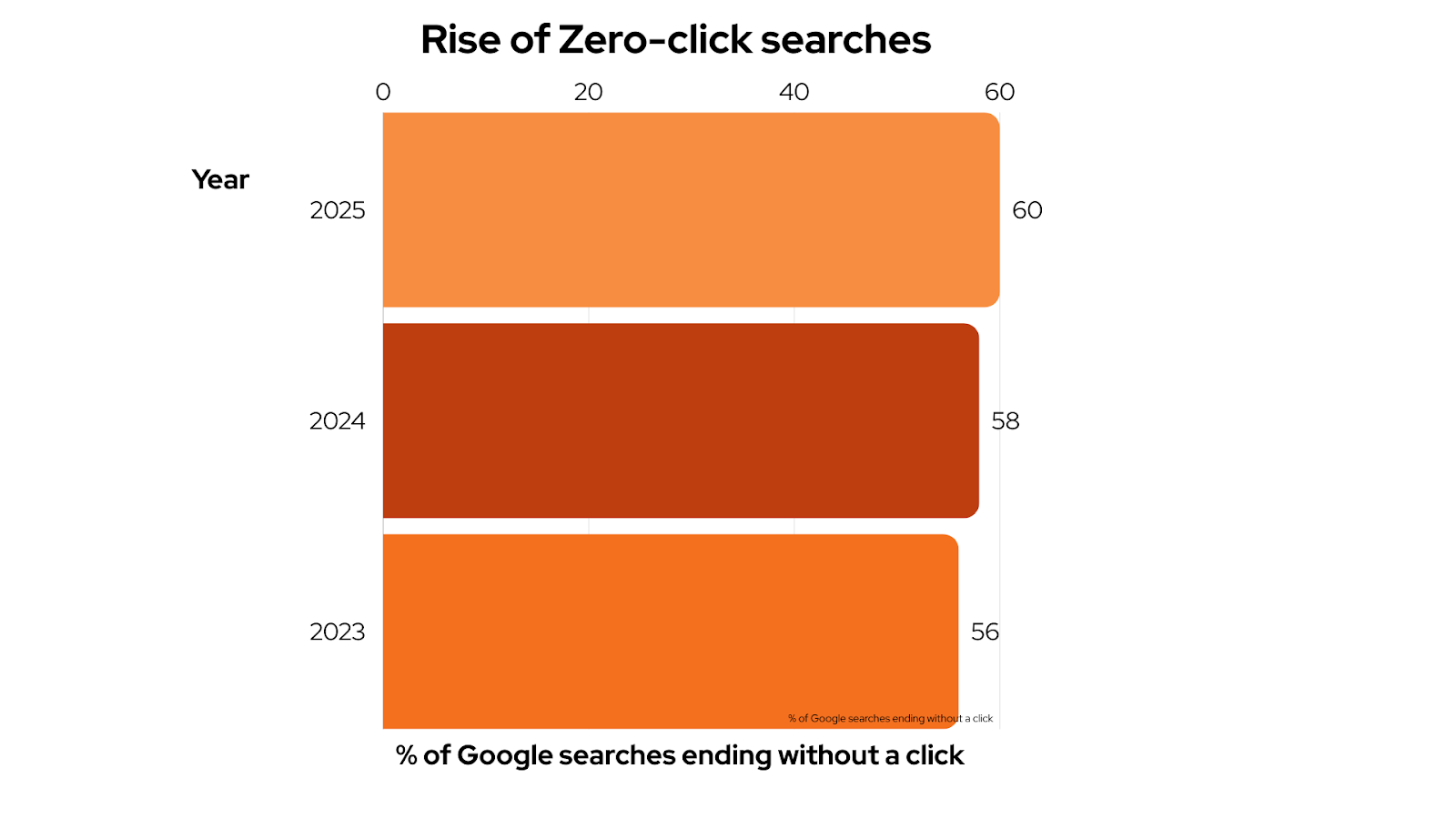
The harder part is figuring out what happens next. With constant traffic drops, leadership wanting answers and still having to fall back on vanity metrics that does not quite hold up anymore to explain what's going on. That's where the pressure builds up. It's not just having to acquire traffic but it's around how decisions get made when the signals aren’t as clean as they used to be.
The Drivers Behind the Shift
Zero-click search Is becoming the norm
Search results don’t just point to answers anymore, they are the answers. Featured snippets, knowledge panels, and AI-powered SERPs increasingly give users what they need without a click. Research has shown that the majority of searches now end directly on the results page, not on a website (Fishkin & Fishkin, 2025).
From a user perspective, this is convenient but from a marketing perspective, it’s unsettling. Engagement is still happening, it's just harder to measure. When fewer users click through, traffic becomes a weaker signal, and attribution starts to feel… thin. Not wrong, just incomplete.
AI summaries are changing how information is consumed
In addition to zero-click search, AI summaries are becoming the default way people consume information. For years, SEO was a relatively stable game. You invested in the “right” content, optimized for the right keywords, and waited for clicks to follow. Ranking well meant visibility, and visibility usually meant traffic. But large language models (LLMs) have changed that dynamic. Today, search engines don’t just point users to content — they absorb it, repackage it, and deliver the answer directly through AI summaries. Often, this happens without sending users further down the funnel. Your content can be highly visible and still generate no visit at all. While these summaries sometimes link back to original content, many users don’t click further especially when their intent is purely informational.
And even when they do, those journeys aren’t always cleanly traceable in analytics tools. The result is less direct traffic and less visibility into how users actually got there (Beshay, 2025). For those of us in marketing, this means fewer clear paths to measure which are harder to explain.
Dark social is quietly doing the heavy lifting
Then there’s everything that happens off the record. Slack messages, group chats, DMs. That link someone dropped into WhatsApp that quietly drove real interest, but shows up as “direct” traffic in Google Analytics (Into, 2025).
Dark social has always existed, but its role has grown. And traditional analytics still struggle to account for it. Engagement is real, but it’s fragmented and misattributed (Into, 2025). You’re not missing demand. You’re missing visibility.
Direct connection becomes the strategy
In response, more teams are leaning into what they can control- owned channels and first-party data. Email, communities, apps, subscriptions, and logged-in experiences give teams clearer signals and more control.
HubSpot frames this shift as a move toward permission-based, durable relationships where data quality matters more than reach (Kowalska, 2025).
If traffic is unreliable, measurement quality matters more than volume
Here’s the uncomfortable truth: traffic was always an incomplete metric. It’s just more obvious now.
High traffic doesn’t mean much if users don’t convert, engage, or return. High volume with no outcome is still failure, just dressed up nicely in a report. Traffic is only one step in the journey, and often the least informative one.
That’s why many teams are moving away from surface-level volume metrics and toward quality-based signals that reflect real intent and impact. Metrics like lead quality, conversion rate, customer acquisition cost (CAC), and customer lifetime value (LTV) tell you far more about whether marketing is working than just traffic ever could. These metrics help answer the questions leadership actually cares about: Are we attracting the right people? Are they moving forward? And does this activity translate into revenue or retention? (Decima, 2025).
This shift is also driven by a growing awareness of how misleading vanity metrics can be. Website traffic, Impressions, or open rate in isolation can look good in a report, but they rarely explain performance or guide decisions. A campaign with lower traffic but higher-quality leads is often far more valuable than one that drives volume without conversion. Quality metrics equip teams to adjust strategy, allocate budget and explain their decisions better — especially when traffic and attribution become noisy (Impactiq, 2025).
The real gap today isn’t reach, it’s understanding. Most teams can say what happened but far fewer can confidently say why or what to do next. And that’s where decision-making slows down.
Shifting the conversation: from acquisition to decision quality
For a long time, marketing success was framed almost entirely around acquisition. More traffic, more reach, more impressions. If numbers went up, things were working. If they went down, something was broken.
That model made sense when traffic was predictable and attribution paths were relatively clean. But today, acquisition alone doesn’t explain much. You can drive traffic without understanding intent. You can hit volume targets without knowing whether the right people showed up or what they did next.
The next phase was attribution. Teams tried to answer which channels were responsible for results. But attribution has its own limits. Dark social, cross-device behavior, AI summaries, and privacy changes have made clean attribution increasingly difficult. In many cases, attribution models create just enough confidence to argue but not enough clarity to decide.
That’s why the conversation is shifting again, this time toward decision quality. This means treating metrics as a product, not a byproduct. Definitions need to be explicit. Lineage needs to be visible. And the “source of truth” can’t be ambiguous.
This shift aligns with broader research on data-driven organizations, which shows that high-performing teams focus less on reporting volume and more on whether insights are explainable, trusted, and actionable (Sainam et al., 2022; Flynn et al., 2023). When analytics and business logic align, teams spend less time debating numbers and more time making decisions.
Tools like Tinkery exist to make that shift practical, by turning metrics from something teams argue about into something they align on.
What marketing teams are doing instead
In reality, this shift doesn’t look like a single big change. It shows up as a series of smaller, deliberate adjustments.
Teams are investing more seriously in first-party data, not just collecting it, but actually organizing and using it. Instead of relying solely on third-party signals or anonymous traffic, they’re prioritizing data they can connect to real users and real behavior (Kowalska, 2025).
There’s also growing investment in customer data platforms (CDPs) and analytics stacks that unify data across tools. The goal isn’t just better reporting, but fewer contradictions between tools— fewer moments where marketing, sales, and product are all “right” in different ways.
Attribution models are being simplified and re-centered around outcomes, not perfection. Rather than chasing a flawless multi-touch model, teams are asking which signals consistently correlate with conversion, retention, or revenue.
Experimentation is playing a bigger role too. Instead of treating reports as the final answer, teams are using experimentation frameworks to test assumptions and learn quickly. This replaces endless debate with evidence, and dashboards with iteration (Gupta, 2025).
And importantly, teams are still using AI but more carefully. AI helps summarize surface patterns, while humans stay accountable for decisions grounded in metrics they trust (Gartner CMO Spend Survey, 2024).
Why this matters — The bigger strategic impact
Flat traffic isn’t a crisis. It’s a reality check. It exposes how much modern marketing depends on decision clarity, not just visibility. When clicks disappear, teams with weak measurement struggle. Teams with trusted metrics move faster.
Organizations that adapt to this shift gain more than better dashboards. They gain speed. They reduce internal friction. They spend less time defending metrics and more time acting on them.
Research consistently shows that teams with higher measurement maturity, those that prioritize clarity, consistency, and trust, outperform teams that rely on volume alone (Gartner CMO Spend Survey, 2024). Not because they have more data, but because they know what to do with it.
Conclusion
Traffic may be flat. That doesn’t mean marketing is stalled. The advantage now isn’t who captures the most attention — it’s who can interpret signals with confidence and act without hesitation. That requires more than dashboards. It requires metrics that are understood, trusted, and shared across teams.
The teams that will succeed next aren’t the ones chasing every click. They’re the ones reorganizing around intent, outcomes, and decisions that actually move the business forward. That’s what decision quality looks like. And increasingly, that’s what modern marketing is optimizing for.
----
References
Beshay. (2025, July 22). Google users are less likely to click on links when an AI summary appears in the results. Pew Research Center. https://www.pewresearch.org/short-reads/2025/07/22/google-users-are-less-likely-to-click-on-links-when-an-ai-summary-appears-in-the-results/
Decima, C. (2025, November 24). Marketing Metrics That Matter: What to Track in 2026. WSI World. https://www.wsiworld.com/blog/marketing-metrics-that-matter-what-to-track-in-2026#:~:text=Lead%20quality%20score,do%20these%20measurements%20really%20mean?
Fishkin, R., & Fishkin, R. (2025, January 27). 2024 Zero-Click Search Study: For every 1,000 EU Google Searches, only 374 clicks go to the Open Web. In the US, it’s 360. SparkToro. https://sparktoro.com/blog/2024-zero-click-search-study-for-every-1000-us-google-searches-only-374-clicks-go-to-the-open-web-in-the-eu-its-360
Flynn, J., Cantrell, S., Mallon, D., Kirby, L., & Scoble-Williams, N. (2023). The transparency paradox: Could less be more when it comes to trust? Deloitte Insights. https://www.deloitte.com/us/en/insights/topics/talent/human-capital-trends/2024/transparency-in-the-workplace.html
Gartner’s 2024 CMO spend survey. (2023). In Gartner. https://www.gartner.com/en/documents/5544295
Guevara, P. (2025, March 31). Quality Metrics: What they are & How to use them | SafetyCulture. SafetyCulture. https://safetyculture.com/topics/quality-metrics
Gupta, A. (2025). From Weeks to hours: How AI is revolutionizing product experimentation (And why most PMs are still doing it wrong). Medium. https://aakashgupta.medium.com/from-weeks-to-hours-how-ai-is-revolutionizing-product-experimentation-and-why-most-pms-are-still-be212d7a23e9
Impactiq. (2025, July 1). The death of vanity Metrics (And what to track instead). Impact IQ Marketing. https://impactiqmarketing.ca/blog/the-death-of-vanity-metrics-and-what-to-track-instead/?srsltid=AfmBOorD-kpknttqhkMKxWKXeZB5XOokowaMbF0AcUeG2DG2aDgRBgSW#:~:text=What%20Are%20Vanity%20Metrics?,Bounce%20rate%20on%20its%20own
Into. (2025, October 14). Dark Social Traffic: Measuring the untrackable in digital marketing. 1into2 Digital. https://www.1into2.com/dark-social-traffic-measuring-untrackable-digital-marketing/#:~:text=The%20trajectory%20is%20unmistakable:%20private,sharing%20hide%20in%20the%20shadows.
Kowalska, K. (2025, November 6). What is first-party data (+ second-party and third-party data)? https://blog.hubspot.com/service/first-party-data
Kuryatnik, V. (2025, December 14). 2025 Organic Traffic Crisis: Zero-Click & AI Impact Analysis Report. Digital Marketing Agency for Predictable Growth. https://thedigitalbloom.com/learn/2025-organic-traffic-crisis-analysis-report/
Paxton, C. (2025, September 10). Are you experiencing a decline in organic traffic? You’re not alone. Akeneo. https://www.akeneo.com/blog/decline-in-organic-traffic
Sainam, P., Auh, S., Ettenson, R., & Jung, Y. S. (2022, July 27). How well does your company use analytics? Harvard Business Review. https://hbr.org/2022/07/how-well-does-your-company-use-analytics
.svg)
It’s time to stop fighting your data
Whether you’re scaling a startup or running lean at a growth stage, you need reporting you can trust and data you don’t have to babysit.


