.svg)

.svg)
.svg)
What is a business digital twin?
One of the strangest characteristics of modern companies is that, despite being surrounded by more information than at any other point in history, they often possess only a fragmented understanding of themselves.
This usually becomes visible not during quarterly planning sessions or board meetings, but during periods of operational stress. A sales organization misses targets despite healthy pipeline creation. Marketing efficiency appears stable while profitability quietly deteriorates underneath. Retention weakens among customer cohorts that every dashboard still classifies as “healthy.” Leadership teams spend hours debating why performance changed, only to discover that each department is operating from slightly different assumptions, metrics and interpretations of reality.
At first glance, this appears to be a tooling problem. Companies assume they need better dashboards, more integrations, cleaner CRMs or more sophisticated analytics infrastructure. Entire categories of enterprise software have emerged around this assumption.
And yet, after a certain level of organizational complexity, the issue rarely stems from lack of visibility alone.
The deeper problem is that most organizations do not possess a coherent operational model of themselves.
Instead, they operate through fragments.
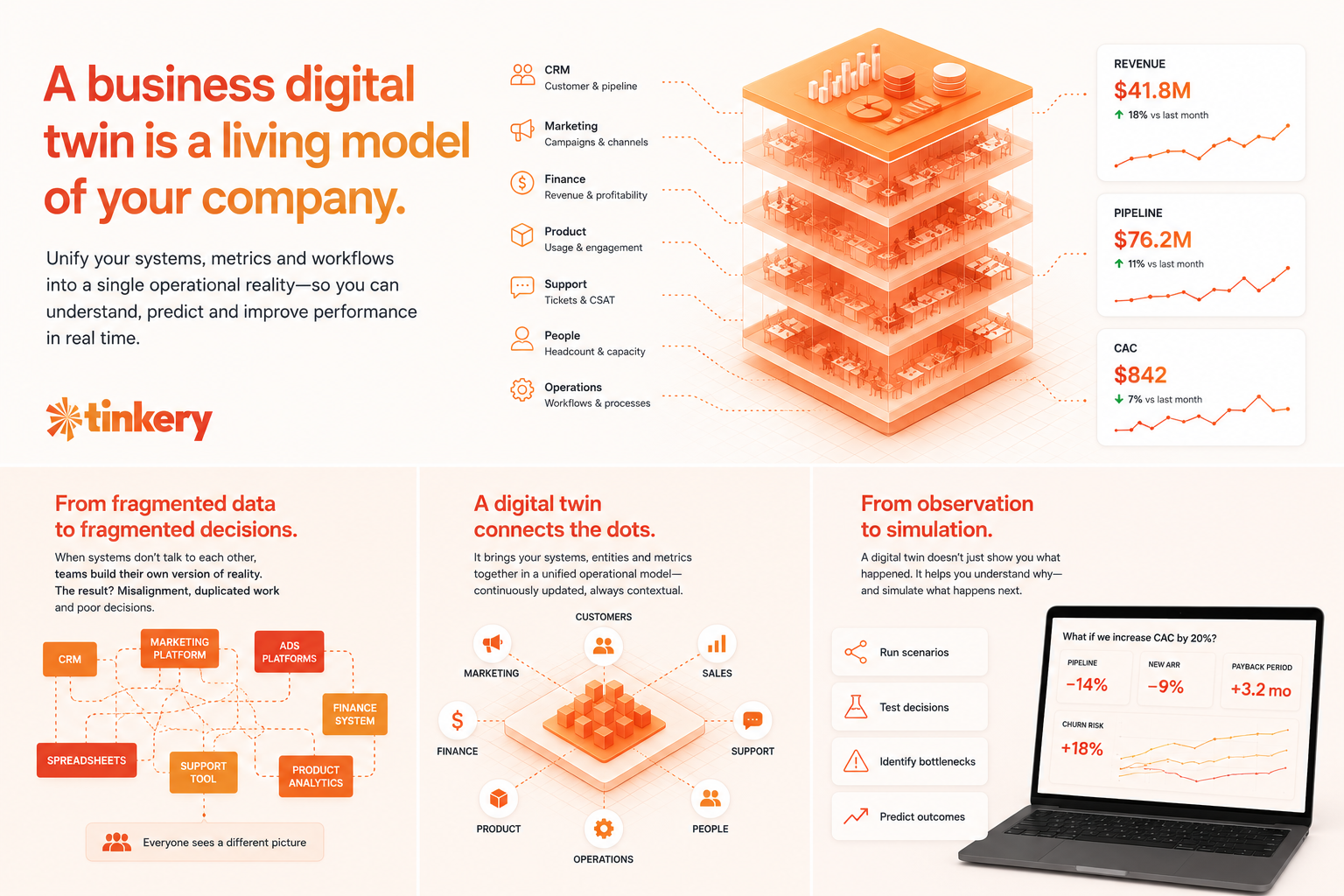
The CRM contains one version of the customer. Finance maintains another. Marketing attribution tells a different story depending on which platform generated the report. Product analytics captures behavior but lacks commercial context. Customer success tracks risk independently from sales. Spreadsheets proliferate quietly across departments, compensating for inconsistencies nobody has fully resolved. Meanwhile, the actual operational knowledge of the business increasingly lives in transient places: Slack conversations, undocumented assumptions, institutional memory trapped inside experienced employees, and mental models that never formally exist anywhere inside the systems themselves.
Humans compensate for this surprisingly well, at least for a while. Organizations function through relationships, intuition and contextual understanding more than most executives would probably like to admit. Experienced operators develop an almost subconscious ability to reconcile contradictions between systems, infer missing context and mentally stitch together operational realities that no single platform fully captures.
But as companies scale, this increasingly becomes fragile.
This is where the concept of a business digital twin starts becoming genuinely important.
The term itself originated far away from software dashboards and commercial operations. In manufacturing, aerospace and industrial engineering, digital twins were developed as virtual representations of physical systems. A factory could create a digital model of its production line, continuously updated through sensors and operational data, allowing engineers not only to monitor performance but to simulate changes, identify bottlenecks and predict failures before they occurred in the real world.
The interesting thing is not the technology itself, but the conceptual shift underneath it.
A traditional reporting environment tells you what happened.
A digital twin attempts to model how the system actually behaves.
Increasingly, the same distinction applies to modern businesses.
Most companies today still operate through retrospective observation. Dashboards show revenue movement, pipeline creation, campaign performance or churn rates, but they rarely represent the deeper relationships between those variables. They expose outputs without truly modeling the underlying operational dynamics generating them.
A business digital twin, at least in its emerging form, attempts something more ambitious. It seeks to create a living operational representation of the organization itself: its customers, workflows, dependencies, commercial motions, operational bottlenecks, revenue dynamics and strategic relationships.
This matters because businesses are not collections of isolated metrics. They are interconnected systems.
A deterioration in SDR response times may eventually influence enterprise conversion rates three quarters later. Changes in pricing structure may subtly alter customer acquisition patterns across specific geographies before appearing in topline revenue. Customer success workload may begin influencing expansion revenue long before churn metrics visibly deteriorate. Marketing channel optimization can unintentionally distort downstream sales quality in ways that remain invisible inside conventional attribution reporting.
Traditional dashboards struggle with this because they are fundamentally observational. They present snapshots of individual variables, often disconnected from the broader operational system generating them.
The larger and more complex the organization becomes, the more dangerous this fragmentation grows.
One of the more interesting paradoxes of the modern software era is that companies frequently become less operationally coherent as they invest more heavily in analytics infrastructure. Every department gains access to more dashboards, more reporting environments and more specialized tooling, yet the organization itself gradually loses the ability to maintain a unified understanding of reality. Teams optimize locally while visibility becomes globally fragmented.
This is partly why so many executives privately distrust their own reporting environments despite publicly celebrating data-driven cultures. The issue is rarely that the numbers are completely wrong. It is that no single system captures the organization as an interconnected operational organism.
The emergence of AI is accelerating this problem dramatically.
For years, organizations could tolerate fragmented operational understanding because humans remained the primary reconciliation layer between systems. People interpreted inconsistencies manually. Meetings resolved semantic ambiguity. Institutional knowledge compensated for missing context. Operators developed intuition around which reports to trust and which metrics required “adjustment” before strategic decisions could be made.
AI changes expectations entirely.
The moment companies begin deploying agents, copilots and automated reasoning systems across operational environments, the absence of coherent organizational models becomes painfully exposed. AI systems can process astonishing amounts of information, but they depend heavily on the structural consistency of the operational reality surrounding them. If the organization itself contains contradictory customer definitions, inconsistent attribution logic, fragmented ownership models and incompatible metrics, AI does not magically resolve these tensions philosophically. It simply generates increasingly sophisticated interpretations of fragmented realities.
This is why many AI analytics experiences today feel simultaneously impressive and strangely unreliable. The interface appears intelligent. The underlying organizational model remains incoherent.
A true business digital twin requires something much deeper than centralized reporting. It requires organizations to build shared operational semantics: consistent customer definitions, canonical metrics, reconciled entities, contextualized workflows and explicit relationships between systems that historically evolved independently from one another.
In practice, this turns out to be less of a technological challenge than an organizational one.
Because businesses are full of invisible disagreements about reality.
Sales and marketing rarely define pipeline identically. Finance often interprets revenue differently from operations. Customer health varies depending on which department owns the relationship. Attribution changes according to which budget is under scrutiny. Even concepts as apparently straightforward as “customer,” “active account” or “qualified lead” frequently conceal layers of unresolved ambiguity accumulated over years of growth.
A business digital twin forces organizations to confront these inconsistencies because simulation requires coherence.
And simulation is where things become particularly interesting.
The real promise of digital twins is not improved reporting. It is operational reasoning.
Once an organization possesses a sufficiently coherent operational model of itself, entirely new capabilities begin to emerge. Businesses move beyond simply observing performance toward understanding systemic relationships, identifying hidden dependencies and evaluating strategic scenarios before they unfold operationally.
The shift resembles the difference between reading weather reports and modeling climate systems.
A mature business digital twin could eventually allow organizations to explore questions that traditional dashboards struggle to address meaningfully. What happens to enterprise pipeline quality if marketing efficiency improves while SDR capacity remains constrained? How does pricing pressure influence long-term retention dynamics across specific customer segments? Which operational bottlenecks most strongly influence expansion revenue over time? What downstream effects emerge if customer onboarding slows by fifteen percent during periods of accelerated acquisition?
These are not merely reporting questions. They are system-behavior questions.
And increasingly, they may define competitive advantage.
The companies that navigate the next decade most effectively may not necessarily be those with the largest datasets or the most advanced AI models. They may simply be the organizations capable of constructing the clearest operational representations of themselves: companies that understand not only what is happening, but how and why their commercial systems behave the way they do.
For decades, enterprise software focused primarily on digitizing business activity. CRMs captured records. ERPs tracked operations. Analytics platforms visualized outcomes.
The next phase may be less about recording the business, and more about modeling its reality continuously enough that organizations can finally reason about themselves as living systems rather than disconnected collections of reports.
And that is ultimately what makes the idea of a business digital twin so important.
Not because it represents another analytics category.
But because it reflects a deeper transition in how organizations understand themselves.
.svg)
It’s time to stop fighting your data
Whether you’re scaling a startup or running lean at a growth stage, you need reporting you can trust and data you don’t have to babysit.


