.svg)
.png)

.svg)
.svg)
Your AI initiative is failing. Here's the real reason.
I've spent years inside companies that were, by any reasonable measure, sophisticated operators. Global pharma. Hypergrowth SaaS. Scaleups with serious investors and world-class GTM teams. These were not naive organizations. They had CRMs, data stacks, BI tools, Notion wikis, enablement decks, attribution models, and more dashboards than anyone could comfortably ignore.
And still — reliably, quietly, repeatedly — the same thing happened.
The same strategic conversation would resurface six months later, with no one acknowledging it had already happened. A key account would churn for a reason that was, if you dug for it, documented somewhere — buried in a CRM note, a support ticket, a Slack thread that nobody thought to tag properly. A new VP would spend their first quarter reconstructing institutional knowledge that technically existed, dispersed across systems and the memories of people who had since left.
This wasn't a technology failure. These companies had plenty of technology.
It was a memory failure.
And I'd mostly filed it under "the cost of growth". That is, the inevitable friction of scaling a human organization. Until AI made it impossible to ignore.
Here's what's actually happening inside most enterprise AI deployments right now: companies are layering intelligence on top of organizational amnesia and wondering why the output feels brittle.
The demos work. Of course they do — demos are curated. The model summarizes, drafts, synthesizes. It's genuinely impressive. But then someone asks it something that requires real context. Why did we lose the Acme deal? What changed in our positioning last quarter? What's the actual definition of "qualified pipeline" that sales and marketing both agree on? And the whole thing starts to wobble.
This is being misdiagnosed, constantly, as a model problem. Wrong model, wrong prompt, wrong vendor. So companies swap tools, run another proof of concept, hire an AI consultant, and eventually conclude that maybe AI "isn't quite there yet" for their use case.
That's the wrong conclusion. The model isn't the problem. The problem is what you're feeding it.
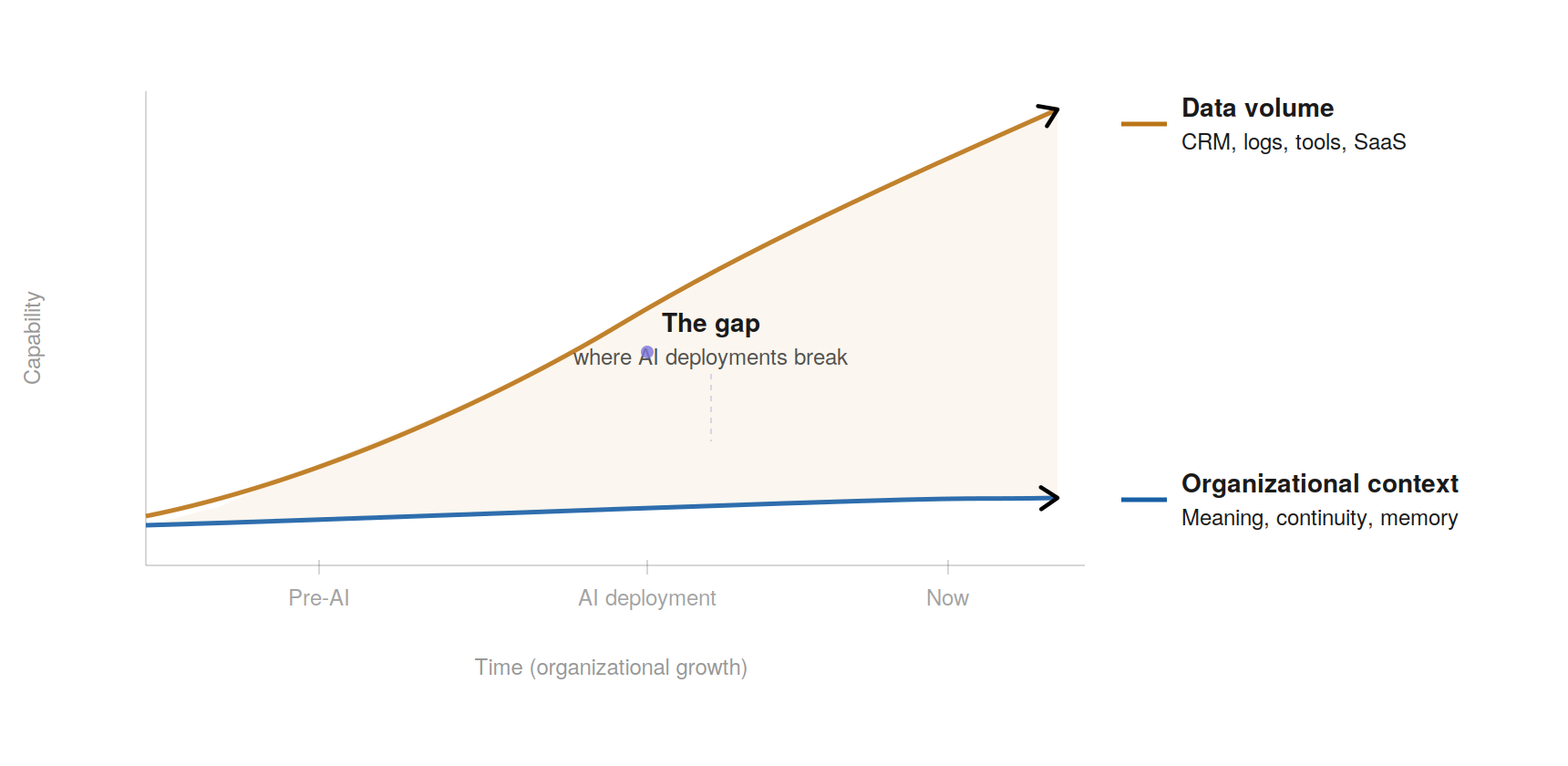
Most GTM teams I've worked with are operating what I'd call information-rich, context-poor organizations. There's no shortage of data. There's a profound shortage of meaning that travels with it across time.
Your CRM has a version of the customer. Your marketing automation has a different one. Finance has its own. Your CS platform has escalations that never made it back to the account record. The actual strategic decisions — why you repositioned, why you sunset that product line, why that partnership fell apart — live in someone's head, or in a slide deck from an offsite that nobody filed anywhere sensible.
Humans navigate this reasonably well. We're contextual machines. We infer. We fill gaps. We pick up the phone and call the person who was in the room.
AI doesn't do that. It works with what's there. And what's there, in most organizations, is a set of fragments that don't fully agree with each other.
So you get AI that's confidently wrong. Or AI that hedges everything into uselessness. Or AI that produces beautiful summaries of fundamentally inconsistent realities.
None of these failures are the model's fault.
The gap that's being exposed here isn't a technology gap. It's a memory architecture gap.
There's an important distinction between data and memory that I think gets glossed over constantly in the AI conversation. Data is accumulation — records, logs, outputs. Memory is something different: it's contextualized continuity. It's not just what happened, but why, and what it meant, and how it connects to what came next.
Organizations have invested billions in the first thing and almost nothing in the second.
And for a long time, that was fine. Software was passive infrastructure. It stored things. Humans assembled meaning. The humans who'd been around long enough to hold the real context were your most valuable operators, and everyone kind of knew it, even if the org chart didn't say so.
AI breaks that model. Not because AI replaces those people — it doesn't, yet — but because it changes what the system is expected to do. When you deploy an agent or a copilot, you're asking software to be an active participant in decisions. And active participants need coherent memory, not just access to a data warehouse.
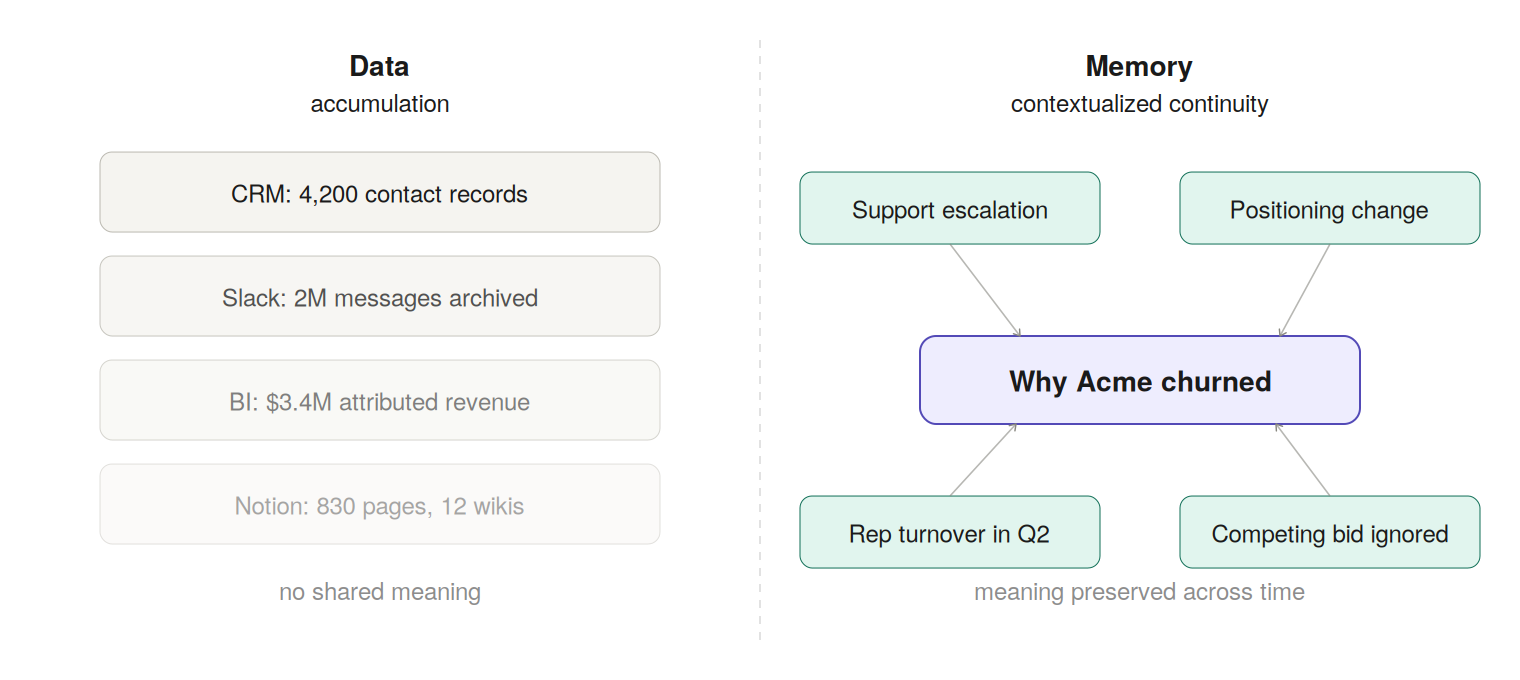
The GTM implications of this are significant, and largely underappreciated.
Think about what genuine organizational memory would mean for a revenue team. A new AE joins and has actual context on the accounts they're inheriting — not just CRM fields, but the real history: what was promised, where trust broke down, what the champion cared about. A campaign team doesn't reconstruct attribution logic from scratch every quarter because the reasoning behind the last model is preserved somewhere findable. An exec doesn't walk into a board meeting having silently contradicted a strategic decision made eight months ago, because the organization has some mechanism for maintaining consistency over time.
This isn't science fiction. It's just an engineering and operational problem that most companies haven't seriously prioritized because they didn't have to. Now they do.
The organizations that figure this out first — that build actual memory architecture into how they operate, not just more tools on top of the same fragmented substrate — are going to have a structural advantage that compounds. Not because they have better AI. Because they have better inputs.
I want to be honest about how hard this is, because I think a lot of the discourse around it is too optimistic.
Building organizational memory isn't a prompt engineering problem. It isn't solved by better tagging in Hubspot, or migrating to a newer CRM, or adding another integration to your data stack. It requires genuinely rethinking how knowledge is captured, structured, maintained, and made accessible — not just at the point of input, but over time, as context evolves.
Most organizations will not do this proactively. They'll do it reactively, after enough AI initiatives have underdelivered to make the root cause undeniable.
But the ones who see it coming — the operators who recognize that the problem isn't intelligence, it's memory — are going to be in a very different position. They'll be the ones whose AI actually works. And increasingly, that's going to look like a competitive moat that's hard to explain and even harder to replicate.
Which, when you think about it, is exactly what real institutional memory has always been.
.svg)
It’s time to stop fighting your data
Whether you’re scaling a startup or running lean at a growth stage, you need reporting you can trust and data you don’t have to babysit.


